A quick blog to remind you of Friday's class:
1. We have all the vocabulary for Unit 3 -- which means a review day and a quiz next week. We will then move to 11 words per unit due to our class size.
2. Using English Grammar 101 website (link on blog), we reviewed the difference between adjectives and adverbs, differentiated between coordinating and cumulative adjectives, and recognized the issues of double comparisons, double negatives, and dangling modifiers.
3. Work time on Narrative Warm-ups. For Monday's class, you will need all three warm-ups completed. We will look at more narrative samples and then it will be time for your own. These warm-ups will help you find a story or a direction for your own writing.
Friday, September 11, 2015

Thursday, September 10, 2015
The Narrative Dialogue
As noted in class today, dialogue can be a significant reflection of character (as in our little partner conversations) and a contributor to the theme (as in "My Mother Never Worked). While dialogue can invigorate a narrative, it does not have to be part of successful writing. Utilizing imagery, character development, and time will provide a story with all it needs.
For homework, answer Narrative Warm-up #3 questions. Do not worry about complete sentences on this one. Jot down responses -- especially those that quickly pop up in your mind. Your instant reactions may provide insight and topics for your writing next week.
For homework, answer Narrative Warm-up #3 questions. Do not worry about complete sentences on this one. Jot down responses -- especially those that quickly pop up in your mind. Your instant reactions may provide insight and topics for your writing next week.
Wednesday, September 9, 2015
Pronoun Dialogue
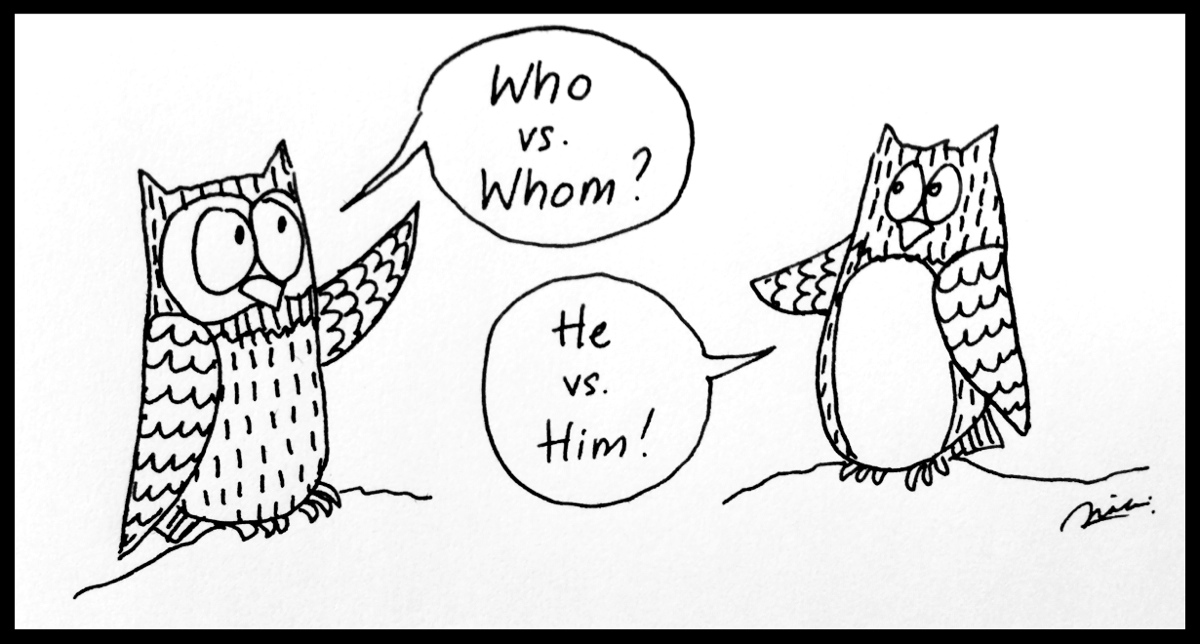
After leaving 4 new vocabulary words today (usurp, vacillate, talisman, expurgate), we reviewed the pronoun handout. Remember, the differentiation between subjective and objective pronouns will help you determine whether it is I or me, we or us, or who (hoot) and whom. For the second half of class, we worked on a partner project involving dialogue. During tomorrow's class, we will share our character conversations and read another example of narrative.
 http://blogs.bu.edu/core/files/2013/10/WhovsWhom2.jpg
Tuesday, September 8, 2015
Narratives & Pronouns
Just a brief synopsis of today's agenda:
1. 4 new vocabulary words.
2. Discussion of "Only Daughter" for its narrative qualities.
3. Pronouns - we focused on subjective and objective pronouns in relationship to verb usage, we reviewed possessive usage of apostrophes and when not to use apostrophes, and we hooted with our who and whom lesson. If you didn't finish up during class time, make sure to have the pronoun handout ready to go for tomorrow.
For Wednesday's class, we will be working on dialogue and how to utilize conversation to understand characters.
1. 4 new vocabulary words.
2. Discussion of "Only Daughter" for its narrative qualities.
3. Pronouns - we focused on subjective and objective pronouns in relationship to verb usage, we reviewed possessive usage of apostrophes and when not to use apostrophes, and we hooted with our who and whom lesson. If you didn't finish up during class time, make sure to have the pronoun handout ready to go for tomorrow.
For Wednesday's class, we will be working on dialogue and how to utilize conversation to understand characters.
Monday, September 7, 2015
Narration
During Friday's class, we began our next mode of discourse: the narrative. There are 5 factors to consider when analyzing and writing narratives. First, every narrative should be centered around a theme. For instance, "Coming to an Awareness" focuses on how education creates empowerment through the experiences of Malcolm X and his time in jail. Second, narratives must consider how to use time, whether for chronological, linear progression or for the manipulation of plot via flashbacks and flashforwards (a word I first heard used in Funny Farm long ago). Third, narratives revolve around characters with the protagonist the most important one. Remember, you want to be selective with whom you place in your story. Fourth, narratives allow one to incorporate dialogue. However, dialogue should be used sparingly and for specific, memorable commentary. Fifth, imagery remains a holdover from descriptive writing. The best stories take the reader into the setting and allow him/her to meet the characters and become part of the plot.
For Tuesday's class, make sure to read "Only Daughter" and prepare responses to the five narrative questions. You will discussing this narrative for participation points, so make sure you are ready to speak.
I hope you have enjoyed your Labor Day weekend. I had the opportunity to visit iheartfink's atelier this weekend and try on a few looks from her runway show. And before you point out my lack of capitalization in the previous sentence, the brand is not capitalized and it is all one word!
And, I did put in the extra credit points. You may want to look at your grades in the next few days as many more assignments will be added into the mix and the grade will inevitably drop to a more realistic number.
For Tuesday's class, make sure to read "Only Daughter" and prepare responses to the five narrative questions. You will discussing this narrative for participation points, so make sure you are ready to speak.
I hope you have enjoyed your Labor Day weekend. I had the opportunity to visit iheartfink's atelier this weekend and try on a few looks from her runway show. And before you point out my lack of capitalization in the previous sentence, the brand is not capitalized and it is all one word!
And, I did put in the extra credit points. You may want to look at your grades in the next few days as many more assignments will be added into the mix and the grade will inevitably drop to a more realistic number.
Wednesday, September 2, 2015
Descriptive Assessment
Today was the last day of descriptive writing. While description sounds rather easy in comparison to the steps and research required in process analysis or argumentation, we have spent a great deal of time focusing on the details (imagery using all of the senses, paragraph and essay structure, hooks and introductions, capitalization, & verb choices). The deadline for the descriptive essay final draft is 3:30 p.m. on Friday, September 4. Turn in hard copy. If you are absent for the entirety of the day, the deadline holds, but you may e-mail an attachment or share with me the essay.
See you on Friday for vocabulary and new stuff --- narratives & verbs!
See you on Friday for vocabulary and new stuff --- narratives & verbs!
Tuesday, September 1, 2015
Yes, Double Space Everything
On the descriptive writing front, Adv. Comp focused on the remaining parts of essay structure: body, conclusion, and MLA format. For tomorrow's class, you will need to have a completed first draft of your relative essay. Do not bring a hard copy as we will be sharing and peer editing via computer tomorrow.
Tips:
- Have your essay in MLA format. If you made a mistake, you can correct it during peer review. (If you need a refresher, head to the additional resources section on the blog.)
- Construct an introduction that hooks the audience and provides a thesis, a direction, for your essay.
- Compose body paragraphs that create round characters, full of imagery and small details that reflect a person's identity.
- Finish with a conclusion that is not a summary. Consider what are the most important, lasting ideas that reflect your family and share that with the audience.
Post-lunch brought vocab quiz 2. Any make-up quizzes must be completed by Friday, September 4.
And, we also reviewed identifying nouns and subjects in order to practice capitalization rules. While capitalization may seem easy, it is a mechanical component, when flawed, that creates a great deal of distractions in student essays. Go here for a recap of the main capitalization rules and start editing your essays for errors: https://owl.english.purdue.edu/owl/resource/592/01/ .
Subscribe to:
Posts (Atom)