As noted in class, make sure that you are not using apostrophes, remaining in third person, formatting citations correctly, maintaining the same tense in a paragraph, and varying up verb selections by using more active verbs.
We are almost finished with the review for the final. During tomorrow's class, we will look at punctuation and grammar to prep for those components.
Only four days left of this class! I am thankful for your attention in Advanced Composition, your spirit to learn grammar and writing, and your participation in the random conversations that somehow hijack our class on a regular basis.
Monday, December 14, 2015

Sunday, December 13, 2015
Final Format
Monday's class will be about your first drafts and a few items that you can do to edit your essays to a higher level. Tuesday's class will be the official review day, an review that was shared with you on Friday.
To give you a picture of the final, here are the components for evaluation.
1. A grammar edit of a paragraph. For this this grammar work, you will only make corrections to better the writing.
2. A punctuation edit for a paragraph. For this punctuation work, you will add and delete punctuation marks.
3. Given a broad topic, you will construct 1-2 paragraph writings for descriptive, narrative, and compare/contrast writing. For instance, on a former final, the topic was vacations. To prepare for this portion of the final, review the components of each writing style so that you can write about the same topic in three different modes.
4. Rhetorical terms. This will include the knowledge of the six rhetorical strategies that we studied in class (tone, diction, syntax, logos, ethos, pathos) and the differentiation of syntax types.
5. You will be given a text and will perform a rhetorical analysis that is not longer than 3 paragraphs.
6. You will define and construct examples of the six stages of argumentation (claim, evidence, warrant, counterclaim, rebuttal, conclusion).
7. For the same text from number 5, you will write a summary.
As you can see, you do not have to write an essay, but you will be utilizing all of the writing techniques to construct paragraphs that represent your understanding of the class.
To give you a picture of the final, here are the components for evaluation.
1. A grammar edit of a paragraph. For this this grammar work, you will only make corrections to better the writing.
2. A punctuation edit for a paragraph. For this punctuation work, you will add and delete punctuation marks.
3. Given a broad topic, you will construct 1-2 paragraph writings for descriptive, narrative, and compare/contrast writing. For instance, on a former final, the topic was vacations. To prepare for this portion of the final, review the components of each writing style so that you can write about the same topic in three different modes.
4. Rhetorical terms. This will include the knowledge of the six rhetorical strategies that we studied in class (tone, diction, syntax, logos, ethos, pathos) and the differentiation of syntax types.
5. You will be given a text and will perform a rhetorical analysis that is not longer than 3 paragraphs.
6. You will define and construct examples of the six stages of argumentation (claim, evidence, warrant, counterclaim, rebuttal, conclusion).
7. For the same text from number 5, you will write a summary.
As you can see, you do not have to write an essay, but you will be utilizing all of the writing techniques to construct paragraphs that represent your understanding of the class.
Friday, December 11, 2015
First Draft Deadline
I hope all of you are feeling a sigh of relief this weekend as you have transferred research essay responsibility to me. I shared the final review handout with you earlier today. We will be discussing this next week, but you are welcome to a preview look. We're almost finished with Advanced Composition.
Wednesday, December 9, 2015
Library Last Day
During today's class, Sources 9 & 10 and the outline were due. I have extended the deadline to the end of the school day for those wrapping up the outline.
We will be in class on Friday. You will have the opportunity to work on your first draft, which is due at the end of the school day. Remember, you will need a 2 pocket folder to turn in your work with the source pages on the left hand side and the remaining written work - claim, intro, outline, first draft - on the right side.
We will be in class on Friday. You will have the opportunity to work on your first draft, which is due at the end of the school day. Remember, you will need a 2 pocket folder to turn in your work with the source pages on the left hand side and the remaining written work - claim, intro, outline, first draft - on the right side.
Tuesday, December 8, 2015
Library Day 4
Working Introduction due today. Sources 9 & 10 and outline due tomorrow. If you need a box outline handout, pick one up during class. The outline is expected to be specific, incorporating claims, all probable evidence, warrants, counterclaim, rebuttal, and conclusion. While this outline will take time, it will allow you to write the essay with greater confidence and speed.
Monday, December 7, 2015
Library Day 3
On the deadlines, today was Sources 5-8 and tomorrow will be the Working Introduction. Sources 9-10, the outline, and the first draft are coming up this week as well!
Friday, December 4, 2015
Library Day 2
Friday continued library research time. Sources 5-8, the working introduction, Sources 9-10, the outline, and the first draft are due next week.
Wednesday, December 2, 2015
Library Day 1
Research continues in the library. Since there is not much action on my end -- other than answering questions and checking your source pages -- I thought I would include cute bunny pictures to liven up the blog.
 |
| https://s-media-cache-ak0.pinimg.com/736x/99/29/72/992972d7b8918707a98ad60fe2622d1d.jpg |
 |
| http://www.acuteaday.com/blog/wp-content/uploads/2012/07/baby-bunnies-in-cups.jpg |
 |
| https://s-media-cache-ak0.pinimg.com/236x/7a/8c/30/7a8c309b04a3e472ae015fe374eb0b67.jpg |
Tuesday, December 1, 2015
Sourcing
The blogs for the upcoming classes will be quite redundant. We will be in the library researching for your argumentative research essay. On Wednesday, the first 4 source pages and the working claim need to be turned in and receive any necessary feedback.
Monday, November 30, 2015
The Final Essay Assignment
During today's class, you received the argumentative research essay assignment. After selecting a casebook from our class textbook, you began the research process by reading and taking notes regarding four related essays. We will continue this tomorrow during class and will move to the library for additional research starting December 2.
Tuesday, November 24, 2015
Argumentation Steps
When we return from break, you will be assigned your final essay assessment: the argumentative research essay. To give you an example on how to organize your essay, albeit an abridged one, you worked in groups to do the following items:
1. brainstorm several possible claims (you want to have options for research)
2. select your working claim (this may be changed, but you want to have a direction)
3. list all examples of evidence
4. group "like" evidence together
5. construct a warrant for each evidence grouping
6. write a counterclaim or select one from the brainstormed claims
7. provide evidence supporting the counterclaim
8. use a rebuttal with additional evidence supporting the original claim
9. construct a concluding statement
As you can see, there are many elements to an argumentative essay, and you will use the nine steps above to construct your essay.
Happy Thanksgiving!
1. brainstorm several possible claims (you want to have options for research)
2. select your working claim (this may be changed, but you want to have a direction)
3. list all examples of evidence
4. group "like" evidence together
5. construct a warrant for each evidence grouping
6. write a counterclaim or select one from the brainstormed claims
7. provide evidence supporting the counterclaim
8. use a rebuttal with additional evidence supporting the original claim
9. construct a concluding statement
As you can see, there are many elements to an argumentative essay, and you will use the nine steps above to construct your essay.
Happy Thanksgiving!
Monday, November 23, 2015
Honey Boo Boo
No better way to review claim, evidence, and warrant and learn about counterclaim and rebuttal than using Honey Boo Boo as a topic. Remember, a counterclaim is another position that you could make regrading the given topic and you can add evidence to support it. It is not the opposite of the claim. A rebuttal is the opportunity to explain why the original claim is stronger than the counterclaim. It is not to show how the counterclaim is wrong.
For homework, annotate the articles regarding the women in the military. We will work on building a full argument in a group environment tomorrow.
For homework, annotate the articles regarding the women in the military. We will work on building a full argument in a group environment tomorrow.
Friday, November 20, 2015
Argumentation Half Review
As we start our last unit, we need to review the components of argumentation. For today's class, those components were the claim, evidence, and warrants. Remember, a claim meets this criteria: not obvious, engaging, specific, logical, debatable, and hypotactic. Evidence can be facts, statistics, historical documentation, expert opinion, and person anecdote. Warrants are the analysis, or the connection, between the claim and evidence. In math, it would look something like this: claim + evidence = warrants.
Next week will be the other parts of argumentation.
Next week will be the other parts of argumentation.
Wednesday, November 18, 2015
Rhetorical Assessment
What an impressive array of rhetorical analysis today! Each group analyzed the required logos, ethos, pathos, diction, tone, and syntax with specific evidence and explanation of purpose. However, what made these presentations impressive was the introductory measures to gain the audience's attention, the natural transitions from one speaker to another, the little dashes of extra strategies to further analysis (such as the parallelism examples), and the ability to communicate with mature, specific, measured diction.
I am so proud of all of you for utilizing your preparation time to construct such intelligent, engaging presentations. On Friday, we begin our last unit: argumentation.
I am so proud of all of you for utilizing your preparation time to construct such intelligent, engaging presentations. On Friday, we begin our last unit: argumentation.
Tuesday, November 17, 2015
Rhetorical Analysis Presentation Prep
After the official assignment, you were assigned a group to complete rhetorical analysis of the Meryl Streep Commencement Speech to Barnard College. During tomorrow's class, you will have the first hour for prep time and the last half hour for presentations.
Monday, November 16, 2015
Eponine, Food, & Meryl
After much technical difficulty, we began class by watching the performance of "On My Own" from Les Miserables. As we noted, Samantha Barks adjusts the tone of the repetitive phrase "I love him" to show the character's lugubrious melancholy and eventual bittersweet hopefulness.
Next, we read an essay on food and identified how the author uses ethos, pathos, and logos to create his purpose. Pay attention to when persuasive appeals are used in a text and why the author is directing this particular order for the audience.
 |
| https://s-media-cache-ak0.pinimg.com/236x/61/4f/85/614f85767603c1c9999b73a15dbb4862.jpg |
During the last half of class, we began the rhetorical analysis assessment -- a verbal group presentation. The text for this assignment is the commencement address at Barnard by Meryl Streep. I have a copy of the transcript for your annotations, but you may watch and listen to her speech at this link: https://www.youtube.com/watch?v=5-a8QXUAe2g .
In class tomorrow, we will go over evaluation expectations and components for a successful presentation. You will also be split into two groups and utilize the remainder of the hour to assign individual assignments and how the presentation will be.
Friday, November 13, 2015
On My Own
Our hour concentrated on the tone map of "On My Own" from Les Miserables. Partnerships created a tone map on construction paper and then wrote a paragraph detailing one pattern from the map and analyzing why the author uses this pattern. If you were absent, you are expected to complete this activity solo.
Logos, ethos, pathos will be the start of next week.
Logos, ethos, pathos will be the start of next week.
Wednesday, November 11, 2015
Tone Mappage
Today we witnessed "desperate" circles of pain, "seductive" winks, and "dreamy" detentions. No, this was not a soap opera; it was our group tone identification skits. Team positive, team negative, and team neutral dazzled us with words and actions befitting their chosen tone words.
From there, we transferred our tone analysis to the written word by reading "Siren Song" and creating a class tone map on the board. Remember, a tone map begins with identifying the shifts of a given text, identifying each section with a specific tone word, indicating two words as the range, and then plotting the points on the map.
At the end of our abbreviated hour, we began "On My Own," in which you identified its tone shifts. During Friday's class, you will create a partner tone map and its additional analysis.
From there, we transferred our tone analysis to the written word by reading "Siren Song" and creating a class tone map on the board. Remember, a tone map begins with identifying the shifts of a given text, identifying each section with a specific tone word, indicating two words as the range, and then plotting the points on the map.
At the end of our abbreviated hour, we began "On My Own," in which you identified its tone shifts. During Friday's class, you will create a partner tone map and its additional analysis.
Tuesday, November 10, 2015
Team Diction and Tone
To wrap up our mini diction unit, you worked in groups to construct a team essay on Emerson's "Education."
For the second half of the agenda, we played with tone and how we can identify varying tones verbally. For next class, we will continue with this step when you "perform" your conversations and your classmates guess your specific tones. Then, we will move into the written word with tone shifts and tone maps.
For the second half of the agenda, we played with tone and how we can identify varying tones verbally. For next class, we will continue with this step when you "perform" your conversations and your classmates guess your specific tones. Then, we will move into the written word with tone shifts and tone maps.
Monday, November 9, 2015
Diction Rhetorical Analysis
To begin class, partnerships shared their diction analysis of the assigned reading for Emerson's "Education." I used too many prepositional phrases in that last sentence, but I accept and acknowledge the fault.
Then, students were assigned groups to make a team essay answering this prompt: How does Emerson use diction to reflect his purpose? Students should have a draft of their individual assignment, i.e. paragraph, for the start of class tomorrow.
*If you were absent, you will be need to write a paragraph on your own answering the above prompt. While this paragraph should be detailed and quite lengthy with evidence, do not feel that you need to analyze all of the diction present in the text. Select a specific type or pattern and concentrate on that for the paragraph. You are creating, in essence, a strong body paragraph.
Then, students were assigned groups to make a team essay answering this prompt: How does Emerson use diction to reflect his purpose? Students should have a draft of their individual assignment, i.e. paragraph, for the start of class tomorrow.
*If you were absent, you will be need to write a paragraph on your own answering the above prompt. While this paragraph should be detailed and quite lengthy with evidence, do not feel that you need to analyze all of the diction present in the text. Select a specific type or pattern and concentrate on that for the paragraph. You are creating, in essence, a strong body paragraph.
Friday, November 6, 2015
Diction
After an impromptu writing time, we began work on our next element for rhetorical analysis: diction. Utilizing quotes and paragraphs, we broke down the usage of diction via patterns, shifts, repetition, and parallelism. The key to analyzing diction is look at each word or phrase and magnify its significance to the text as a whole.
Your syntax essay is due on Monday.
Your syntax essay is due on Monday.
Tuesday, November 3, 2015
Syntax Evaluations
During today's class, you self-evaluated your syntax essays by focusing on the following essentials:
- Providing an original, related hook
- Incorporating the author and title into the introduction
- Answering the prompt in the thesis
- Constructing paragraphs with topic sentences and concluding sentences
- Specifying types of syntax (simple, complex, interrogative, exclamatory)
- Adding evidence from the text with a citation
- Explaining the "why" for every syntax example
- Writing a memorable concluding paragraph
- Writing in present tense
- Writing in third person
- Writing clean, detail-oriented essays
The final draft of the essay will be due on Monday. Tomorrow, we will have a brief question session for you. Then, we will be moving onto diction analysis.
Monday, November 2, 2015
Syntax Prompt
After reviewing syntactical patterns in "Superman & Me," you were given the rest of the hour to complete a 3-4 paragraph mini essay on the following prompt: How does Sherman Alexie use syntax to reflect his purpose in "Superman & Me"? For class tomorrow, bring in a hard copy, which we will be using for self-evaluation purposes.
Wednesday, October 28, 2015
Highlighting That Syntax
For our first strategy of study, we will concentrate on syntax (the what) and the purpose of the author using particular patterns of sentence structure (the why).
While you may also analyze declarative, interrogative, exclamatory, and imperative sentences, we will be concentrating on the following six syntactical structures:
simple = the lonely independent clause
compound = 2 independent clauses with one of those FANBOYS added in for good measure
complex = a combination of an independent clause and a dependent clause (any order and with the possibility of an additional dependent clause(
compound-complex = see aforementioned sentence types and combine into one lengthy construction
cumulative = an independent clause followed by a series of dependent clauses or phrases
periodic = a series of dependent clauses or phrases followed by an independent clause
With these definitions, we identified sentence structures in sample sentences by highlighting clauses and FANBOYS prior to naming the type of sentence. Then, we created our own sentences, which I will make into a future syntax quiz. Last, we read "Superman & Me" by Sherman Alexie to identify the purpose of each paragraph and highlight his choice of syntax.
When I see you again -- Monday, ages from now it seems -- you should have a clear understanding of what types of syntax are used in each paragraph. We will use this information to discuss the patterns of syntax and complete a writing prompt.
Enjoy your Halloween!
While you may also analyze declarative, interrogative, exclamatory, and imperative sentences, we will be concentrating on the following six syntactical structures:
simple = the lonely independent clause
compound = 2 independent clauses with one of those FANBOYS added in for good measure
complex = a combination of an independent clause and a dependent clause (any order and with the possibility of an additional dependent clause(
compound-complex = see aforementioned sentence types and combine into one lengthy construction
cumulative = an independent clause followed by a series of dependent clauses or phrases
periodic = a series of dependent clauses or phrases followed by an independent clause
With these definitions, we identified sentence structures in sample sentences by highlighting clauses and FANBOYS prior to naming the type of sentence. Then, we created our own sentences, which I will make into a future syntax quiz. Last, we read "Superman & Me" by Sherman Alexie to identify the purpose of each paragraph and highlight his choice of syntax.
When I see you again -- Monday, ages from now it seems -- you should have a clear understanding of what types of syntax are used in each paragraph. We will use this information to discuss the patterns of syntax and complete a writing prompt.
Enjoy your Halloween!
Monday, October 26, 2015
Rhetorical Analysis
As an introduction to rhetoric (or the art of argument), we read an essay and identified the what (the strategies and structural concerns) and the why (the purpose). Rhetorical analysis, simply put, is the "what" and the "why." For instance, you noted that the author uses an anecdote of Jodi in the first two paragraphs and analyzed the contrasting diction. Then, you expressed the reasons: to create a relatable scenario for a hook and reflect the theme of the essay regarding economic strife.
In continuance, we began our review of rhetorical strategies -- from the three musketeers of logos, ethos, pathos to other considerations of diction, syntax, tone.
We will finish our review of these terms tomorrow. Then, you will have an independent rhetorical analysis. You will approve of the topic.
In continuance, we began our review of rhetorical strategies -- from the three musketeers of logos, ethos, pathos to other considerations of diction, syntax, tone.
We will finish our review of these terms tomorrow. Then, you will have an independent rhetorical analysis. You will approve of the topic.
Friday, October 23, 2015
C/C Assessment
The compare and contrast St. Louis assessment was the featured item on today's agenda. If you were absent, you will need to make other arrangements to make up this significant assessment.
Enjoy your weekend! We have 2 essays left for this class!
Enjoy your weekend! We have 2 essays left for this class!
Thursday, October 22, 2015
C/C Extravaganza
In order to prepare for your compare and contrast assessment on Friday, we practiced basis, introductions, and body paragraphs on a variety of topics.
If you were absent, you will need to create bases for these topics: spiders/snakes, 2 celebrities (you must select the specific celebrities first) and movies/novels. Then, you will select one basis and write an introductory paragraph. Then, you will select a second basis and construct a body paragraph. Then, you will select the third and last basis to construct a body paragraph. If you choose not to complete these paragraphs, you will not receive participation credit for Wednesday's class.
Be ready for your timed writing on Friday -- you will be able to use your group notes to assist your writing.
If you were absent, you will need to create bases for these topics: spiders/snakes, 2 celebrities (you must select the specific celebrities first) and movies/novels. Then, you will select one basis and write an introductory paragraph. Then, you will select a second basis and construct a body paragraph. Then, you will select the third and last basis to construct a body paragraph. If you choose not to complete these paragraphs, you will not receive participation credit for Wednesday's class.
Be ready for your timed writing on Friday -- you will be able to use your group notes to assist your writing.
Tuesday, October 20, 2015
Student Evaluation
To mix up evaluation of paragraphs, students were responsible for critiquing (or "tearing apart" as one person commented) the compare and contrast writing. Overall, the common criticism revolved around using specific diction and providing specific examples to illustrate the ideas. As a result of these lackluster paragraphs, we will spend tomorrow practicing compare and contrast writing using the topics that you wrote on the communal board.
Outside of class, make sure you complete your St. Louis locale notes. The prompt will be on Friday.
Outside of class, make sure you complete your St. Louis locale notes. The prompt will be on Friday.
Monday, October 19, 2015
The Last Quest
Our vocabulary enrichment is now behind us as we concentrate on compare and contrast writing. Groups resumed their team essay writing on learning and teaching with the final draft turned in today. During tomorrow's class, we will evaluate these essays and then have the remainder of the time to finish your research our St. Louis locales for the group research assignment.
Thursday, October 15, 2015
Team Compare/Contrast
The first part of our class revolved around vocabulary and the competitive review of the units 1-5. The final vocabulary champion is Rowan. Don't forget to prep for the vocab quest on Monday.
Next, we began our team compare/contrast essay on the topics of learning versus teaching. In groups, you spent time constructing a basis to prepare for the writing process, determined a thesis statement for the group's writing, outlined body paragraphs, and began your individual paragraph writing. After our quest on Monday, we will be working on the completion of the team essay.
As you have a three day weekend coming up, don't forget to that you can visit all the local area attractions assigned for your compare and contrast research!
Wednesday, October 14, 2015
The River & Conversation
The last four vocabulary words are in the books. Tomorrow, we will have a super review covering all 5 units. Monday, we will have the Vocabulary Quest covering all of our vocabulary.
In addition to our ever-evolving vernacular, we read two texts to analyze compare and contrast writing: "Two Ways of Seeing a River" by Twain and "Sex, Lies, and Conversation" by Tannen. While we did focus on basis, thesis, and organization, we also discussed some of the topics as well. In addition to analyzing how experience alters the perspective of a river boat captain or a doctor, we discussed how seniors in high school have changed their perspectives over 12 years of education. We also looked at our interlocutor patterns to determine how women and men differ in their expectations of conversational partners.
And, last but certainly not least, you were assigned the group research component for the compare/contrast essay. Your research is due next Wednesday so that I may make copies for your group and for the eventual individual compare and contrast in-class writing prompt.
One more day until our three day weekend! I hope you take the opportunity to visit your research locations.
In addition to our ever-evolving vernacular, we read two texts to analyze compare and contrast writing: "Two Ways of Seeing a River" by Twain and "Sex, Lies, and Conversation" by Tannen. While we did focus on basis, thesis, and organization, we also discussed some of the topics as well. In addition to analyzing how experience alters the perspective of a river boat captain or a doctor, we discussed how seniors in high school have changed their perspectives over 12 years of education. We also looked at our interlocutor patterns to determine how women and men differ in their expectations of conversational partners.
And, last but certainly not least, you were assigned the group research component for the compare/contrast essay. Your research is due next Wednesday so that I may make copies for your group and for the eventual individual compare and contrast in-class writing prompt.
One more day until our three day weekend! I hope you take the opportunity to visit your research locations.
Tuesday, October 13, 2015
Sadie & Maud
After learning four more vocabulary word, we concentrated on activities to practice compare and contrast writing. Up first, "Sadie & Maud," a poem reflecting progeny of the same family with conflicting outcomes in life. Then as partners, you created a basis, thesis, a block or point-by-point evidence outline, and a concluding statement on two items.
Tomorrow brings the last of our new vocabulary words for the class and compare/contrast reading samples.
Tomorrow brings the last of our new vocabulary words for the class and compare/contrast reading samples.
Monday, October 12, 2015
Introduction to C/C
We will resume vocab experts tomorrow and complete the last 8 words of vocabulary this week. The end result will be an overall Vocabulary Quest next week.
To start off our compare and contrast writing unit (if you are counting, we have, including this one, three essays left to go), you were introduced to five key facets of this mode of discourse: the basis (brainstorming, planning component), the thesis (including the purpose and eradicating predictable words such as "similarities" and "differences"), the organization (block versus point-by-point), the transitions (utilizing comparison and contrasting phraseology), and the conclusion (final statement regarding the topics at hand). For tomorrow's expedition, we will start practicing compare and contrast writing and analyzing sample texts.
Make sure you are in class all week: the next essay begins as a group activity and you will need all of your partners on the same page and ready to complete the assigned tasks.
To start off our compare and contrast writing unit (if you are counting, we have, including this one, three essays left to go), you were introduced to five key facets of this mode of discourse: the basis (brainstorming, planning component), the thesis (including the purpose and eradicating predictable words such as "similarities" and "differences"), the organization (block versus point-by-point), the transitions (utilizing comparison and contrasting phraseology), and the conclusion (final statement regarding the topics at hand). For tomorrow's expedition, we will start practicing compare and contrast writing and analyzing sample texts.
Make sure you are in class all week: the next essay begins as a group activity and you will need all of your partners on the same page and ready to complete the assigned tasks.
Friday, October 9, 2015
Finally, The End of the Exemplification Unit
After countless hours of researching and writing, the time has finally arrived: the exemplification essay deadline of 3:30 p.m. on Friday.
For Monday's class, we will review vocabulary and commence our next mode of discourse, compare and contrast writing. For a quick preview, we will be constructing an essay that involves St. Louis and its attractions.
For Monday's class, we will review vocabulary and commence our next mode of discourse, compare and contrast writing. For a quick preview, we will be constructing an essay that involves St. Louis and its attractions.
Wednesday, October 7, 2015
Exemplification Peer Review
Today's class was split into a writing day for the exemplification essay and a peer review session. For Friday's class, we will have vocabulary for the first 5 minutes and then you will have the remainder of the hour to work on the final draft, which includes a Works Cited page. If you have major revisions planned, you will need to work on these outside of class.
Final draft deadline is 3:30 p.m. on Friday.
Final draft deadline is 3:30 p.m. on Friday.
Tuesday, October 6, 2015
Work Day
During today's class, you had ample opportunity to work on your research and exemplification writing. As a reminder, you should work on this assignment this evening in order to have everything finished for tomorrow's class. Agenda for tomorrow will be as follows: 45 minutes to work on draft, 45 minutes to peer review, excess time for vocabulary.
Monday, October 5, 2015
Exemplifying Research
After choosing your abstract noun, the research process has begun in class -- and outside of class. The schedule for this week: Tuesday will be 5 minute vocabulary and then the remainder will be used to research examples and commence your first draft; Wednesday will be 45 minutes of class time for research and first drafting and the remainder of the class will be peer review time - you must have an essay draft at this point; Friday will be vocabulary and then time to work on your final draft during class time. The final draft of the exemplification essay will be due by 3:30 p.m. on Friday.
While we will be dedicating the majority of the week to finishing up the drafts in class, you may need more time outside of class to research and write. Keep this in mind tonight and tomorrow as you exemplify your noun.
While we will be dedicating the majority of the week to finishing up the drafts in class, you may need more time outside of class to research and write. Keep this in mind tonight and tomorrow as you exemplify your noun.
Friday, October 2, 2015
Citing Evil
Takeaways from today's class exemplification, citations, and transitions.
1. Your thesis should directly define your comprehension of the abstract noun. It should not be a dictionary definition.
2. Each body paragraph's topic sentence should connect the abstract noun (evil) to the specific example.
3. Incorporate evidence via paraphrases and direct quotes from multiple sources.
4. Citations, traditionally, feature the author and the page number (Gianini 5). However, if you do not have an author, you should commence with the title of the selection. If you do not have a page number, you just put the author or title.
5. To avoid the immature full sentence quotations, work on selecting key phrases to transition into your writing. Your essays will have better flow and focus more on your writing than other texts.
6. Create a final concluding thought to tie together the example.
Following our evil practice, you were assigned your new vocabulary word for Vocab Experts starting on Monday.
Then, the preview of the exemplification essay. For your essay, you will be selecting an abstract noun from the given list of 441 abstract nouns. (Remember, "chaos" is not allowed due to the student example for next week.) When you walk into class on Monday, you should have a list of 3-5 nouns ready to go. Each student will pick a different noun and then we will discuss research policies, source pages, and the Works Cited Page.
We only have 4 essays left to go in this class -- how time does fly!
1. Your thesis should directly define your comprehension of the abstract noun. It should not be a dictionary definition.
2. Each body paragraph's topic sentence should connect the abstract noun (evil) to the specific example.
3. Incorporate evidence via paraphrases and direct quotes from multiple sources.
4. Citations, traditionally, feature the author and the page number (Gianini 5). However, if you do not have an author, you should commence with the title of the selection. If you do not have a page number, you just put the author or title.
5. To avoid the immature full sentence quotations, work on selecting key phrases to transition into your writing. Your essays will have better flow and focus more on your writing than other texts.
6. Create a final concluding thought to tie together the example.
Following our evil practice, you were assigned your new vocabulary word for Vocab Experts starting on Monday.
Then, the preview of the exemplification essay. For your essay, you will be selecting an abstract noun from the given list of 441 abstract nouns. (Remember, "chaos" is not allowed due to the student example for next week.) When you walk into class on Monday, you should have a list of 3-5 nouns ready to go. Each student will pick a different noun and then we will discuss research policies, source pages, and the Works Cited Page.
We only have 4 essays left to go in this class -- how time does fly!
Tuesday, September 29, 2015
Board Races of Evil
After finishing the last review and practice of grammar, we started our next exemplification activity. Today's abstract noun is evil. During class, we started the process by brainstorming anything and everything that is evil. Then, each of you selected one example to use for further research.
In class tomorrow, we will work more with evil and review how to create citations in writing. the exemplification component will be the first half hour prior to lunch. We may work on this as well on Friday. Then, you will have the GRAMMAR QUEST post-lunch. Make sure to study all your rules, check out englishgrammar101.com and chompchomp.com for more practice.
In class tomorrow, we will work more with evil and review how to create citations in writing. the exemplification component will be the first half hour prior to lunch. We may work on this as well on Friday. Then, you will have the GRAMMAR QUEST post-lunch. Make sure to study all your rules, check out englishgrammar101.com and chompchomp.com for more practice.
Monday, September 28, 2015
Nearing the Quest
These blogs have been fairly short for your class as we have spent the last few days winding down Grammar Boot Camp and preparing for the Quest on Wednesday.
Without much ado...
1. Vocab Quiz 4. If you were absent, you will need to make up the quiz by Friday.
2. Grammar Review Part II. We identified the parts of speech, and I gave you tips to help you recognize different parts of speech. For instance, start by identifying nouns in the sentence. Then, go in this order: pronouns, verbs & infinitives, adjectives & adverbs, conjunctions & prepositions.
3. As individuals and then in small groups, you completed a practice Quest. We will go over the answers tomorrow.
Without much ado...
1. Vocab Quiz 4. If you were absent, you will need to make up the quiz by Friday.
2. Grammar Review Part II. We identified the parts of speech, and I gave you tips to help you recognize different parts of speech. For instance, start by identifying nouns in the sentence. Then, go in this order: pronouns, verbs & infinitives, adjectives & adverbs, conjunctions & prepositions.
3. As individuals and then in small groups, you completed a practice Quest. We will go over the answers tomorrow.
Friday, September 25, 2015
Review Part II
During class, we will be analyzing "The Catbird Seat," an exemplification essay, for its theme, purpose, specific examples, relevancy, and range. Next week, we will return to writing by creating a practice exemplification on an abstract noun-- I promise this one will have more options for you than "creativity" -- and eventually your own exemplification essay. The second part of class revolved around Grammar Review Part II, the sequel. If you are struggling with any sections, utilize practice exercises on englishgrammar101.com and chompchomp.com.
Don't forget the Vocab Quiz on Monday -- it will cover the 11 words from Unit 4 and, of course, feature return words from the previous units.
Don't forget the Vocab Quiz on Monday -- it will cover the 11 words from Unit 4 and, of course, feature return words from the previous units.
Thursday, September 24, 2015
Review
As we may have noticed, we are in review mode for your big Mechanics Quest next week. At this point, you should have completed the first part of the review using englishgrammar101 and the checklist. If you did not have a flawless review, you will need to review and study the specific grammar and punctuation categories. For Friday's class, you will need to arrive with the second review completed. The plan is to go over this handout and then have a practice Quest next week before the real deal.
In addition, we will continue our exemplification unit by reading another brief essay during Friday's class.
In addition, we will continue our exemplification unit by reading another brief essay during Friday's class.
Tuesday, September 22, 2015
Prepositional Cliffhangers!
The title of the blog makes our class sound dramatic! During class, we shared our prepositional short stories, which helped us learn about prepositions and the requirements of prepositional phrases.
Then, we discussed two sins in writing: ending a sentence with a preposition and over-prepositioning (my own term) in writing.
Whenever you notice a preposition at the end of the sentence, you will need to revise the word order and construction of that sentence. For example, "Mrs. Bennet had many grievances to relate, and much to complain of" comes from Jane Austen's pen. This could be rewritten as "Mrs. Bennet had many grievances and complaints to relate."
In addition, you may be the habit of using a great deal of prepositional phrases in your writing. The result = wordiness!
The balloon of blue from the circus floats across the sky with clouds.
The blue circus balloon floats across the cloudy sky.
As for exemplification, we practiced the relevancy, range, and specific aspects using the broad topic of "creativity." For homework, you are to take your assigned specific example and create a paragraph illustrating its creativity. If you were absent, you will need to pick a specific person, place, or object and write a paragraph illustrating how your selection reflects creativity.
Since we ran out of time on vocabulary, we will resume vocab experts tomorrow.
Then, we discussed two sins in writing: ending a sentence with a preposition and over-prepositioning (my own term) in writing.
Whenever you notice a preposition at the end of the sentence, you will need to revise the word order and construction of that sentence. For example, "Mrs. Bennet had many grievances to relate, and much to complain of" comes from Jane Austen's pen. This could be rewritten as "Mrs. Bennet had many grievances and complaints to relate."
In addition, you may be the habit of using a great deal of prepositional phrases in your writing. The result = wordiness!
The balloon of blue from the circus floats across the sky with clouds.
The blue circus balloon floats across the cloudy sky.
As for exemplification, we practiced the relevancy, range, and specific aspects using the broad topic of "creativity." For homework, you are to take your assigned specific example and create a paragraph illustrating its creativity. If you were absent, you will need to pick a specific person, place, or object and write a paragraph illustrating how your selection reflects creativity.
Since we ran out of time on vocabulary, we will resume vocab experts tomorrow.
Monday, September 21, 2015
Exemplifying Prepositional Phrases
After learning four new vocabulary words (catharsis, kudos, risible, estrange), we began our exemplification unit. Exemplification is exactly how it sounds -- a writing style that emphasizes examples. For instance, we brainstormed all the related words and emotions of this general topic: students. Next, we picked "bad decisions" as a theme to clarify a direction to our exemplification. Then, comes the three qualities of exemplification writing: relevancy, range, and specificity. First, relevancy involves selecting the items on the brainstorm that connect with the theme and ditching all the items that do not fit. You can then group the items into usable categories such as social, educational, and emotional for our student examples. Second, range connects to organization of examples. Do you want a chronological order, a least important to most important order, etc. For today, we decided to organize socially then emotionally then educationally. Last, specificity involves taking a vague idea (lunchroom bad decisions) and making these into memorable, specific, image-filled examples (starting a fight over spilled peas). To further instill the exemplification ideas, we read "Be Specific," a short essay detailing the necessity of specific names and information for all objects -- whether it be flower, cheese, or person.
For the creative portion of our show, we reviewed prepositions and prepositional phrases. Remember, a preposition exists in a prepositional phrase. The phrase begins with a prepositional and ends with an object. You can have modifiers to describe the object, but there are no verbs in a prepositional phrases.
With a partner, you drew four random prepositions and created a story in prepositional phrases. Tomorrow, we will start by turning this story into a visualization via construction paper. Ideally, this will help all of us improve with recognizing prepositional phrases -- whether you are a squirrel in a tree, a girl in a bed of spiders, or a high school student asleep on the bus.
See you tomorrow for more exemplifying and prepositional fun!
For the creative portion of our show, we reviewed prepositions and prepositional phrases. Remember, a preposition exists in a prepositional phrase. The phrase begins with a prepositional and ends with an object. You can have modifiers to describe the object, but there are no verbs in a prepositional phrases.
With a partner, you drew four random prepositions and created a story in prepositional phrases. Tomorrow, we will start by turning this story into a visualization via construction paper. Ideally, this will help all of us improve with recognizing prepositional phrases -- whether you are a squirrel in a tree, a girl in a bed of spiders, or a high school student asleep on the bus.
See you tomorrow for more exemplifying and prepositional fun!
Friday, September 18, 2015
Narrative Edit Day
What you learned today:
The narrative essay will be evaluated on 4 areas: idea, organization, voice, and conventions. With the idea, you need a true story with imagery, characters, optional dialogue, and theme. With organization, you need a memorable title, an introduction with a attention-getting hook, sound body paragraphs, transitions between ideas, and a strong conclusion. With voice, pay attention to your word choice by including specific, mature language and active verbs, your originality of expression, and your non-usage of contractions and second person. With conventions, MLA format does matter as well as mechanical conventions.
The final draft is due by 2:45 p.m. on Tuesday.
What I learned today:
Your class is quite competitive and likes the buzzer system. I guess we will have to use that for future vocabulary reviews!
Happy Homecoming!
The narrative essay will be evaluated on 4 areas: idea, organization, voice, and conventions. With the idea, you need a true story with imagery, characters, optional dialogue, and theme. With organization, you need a memorable title, an introduction with a attention-getting hook, sound body paragraphs, transitions between ideas, and a strong conclusion. With voice, pay attention to your word choice by including specific, mature language and active verbs, your originality of expression, and your non-usage of contractions and second person. With conventions, MLA format does matter as well as mechanical conventions.
The final draft is due by 2:45 p.m. on Tuesday.
What I learned today:
Your class is quite competitive and likes the buzzer system. I guess we will have to use that for future vocabulary reviews!
Happy Homecoming!
Thursday, September 17, 2015
Conjunctions & Punctuation
Wednesday was punctuation in Advanced Comp. We practiced punctuation rules regarding dependent and independent clauses, transitional expressions, semicolons, and colons. For homework, you need to finish the highlighting activity, which we will discuss on Friday.
As you now know these punctuation rules, your narrative first drafts, which are due at the beginning of the hour on Friday, should have less distractions. Remember, read your essays out loud to catch your mistakes or needed punctuation.
By the way, if you are serious about a t-shirt for the class, submit designs to me.
As you now know these punctuation rules, your narrative first drafts, which are due at the beginning of the hour on Friday, should have less distractions. Remember, read your essays out loud to catch your mistakes or needed punctuation.
By the way, if you are serious about a t-shirt for the class, submit designs to me.
Tuesday, September 15, 2015
Sample Day
Today's class featured vocab quiz 3 and the assignment of the first 11 words in unit 4. Then, we heard sample narratives from various writing levels: sophomore, junior, and collegiate. Last, we reviewed the difference between independent and dependent clauses in preparation for conjunction and punctuation rules.
Narrative first drafts, whether in hard copy or digital form, must be available at the start of Friday's class for peer and teacher evaluation.
Narrative first drafts, whether in hard copy or digital form, must be available at the start of Friday's class for peer and teacher evaluation.
Monday, September 14, 2015
Narrative Assignment
On our docket today was vocabulary review (Quiz 3 tomorrow), "Porkopolis" college application essay, narrative essay assignment, and narrative warm-ups. When you enter class tomorrow, make sure you know what option you would like to explore in your narrative essay. We will have previous student samples to give you further examples of narrative subjects and characterization. Remember, you will need the first draft of your narrative essay on Friday for peer review and teacher evaluation.
Friday, September 11, 2015
Warming Up
A quick blog to remind you of Friday's class:
1. We have all the vocabulary for Unit 3 -- which means a review day and a quiz next week. We will then move to 11 words per unit due to our class size.
2. Using English Grammar 101 website (link on blog), we reviewed the difference between adjectives and adverbs, differentiated between coordinating and cumulative adjectives, and recognized the issues of double comparisons, double negatives, and dangling modifiers.
3. Work time on Narrative Warm-ups. For Monday's class, you will need all three warm-ups completed. We will look at more narrative samples and then it will be time for your own. These warm-ups will help you find a story or a direction for your own writing.
1. We have all the vocabulary for Unit 3 -- which means a review day and a quiz next week. We will then move to 11 words per unit due to our class size.
2. Using English Grammar 101 website (link on blog), we reviewed the difference between adjectives and adverbs, differentiated between coordinating and cumulative adjectives, and recognized the issues of double comparisons, double negatives, and dangling modifiers.
3. Work time on Narrative Warm-ups. For Monday's class, you will need all three warm-ups completed. We will look at more narrative samples and then it will be time for your own. These warm-ups will help you find a story or a direction for your own writing.
Thursday, September 10, 2015
The Narrative Dialogue
As noted in class today, dialogue can be a significant reflection of character (as in our little partner conversations) and a contributor to the theme (as in "My Mother Never Worked). While dialogue can invigorate a narrative, it does not have to be part of successful writing. Utilizing imagery, character development, and time will provide a story with all it needs.
For homework, answer Narrative Warm-up #3 questions. Do not worry about complete sentences on this one. Jot down responses -- especially those that quickly pop up in your mind. Your instant reactions may provide insight and topics for your writing next week.
For homework, answer Narrative Warm-up #3 questions. Do not worry about complete sentences on this one. Jot down responses -- especially those that quickly pop up in your mind. Your instant reactions may provide insight and topics for your writing next week.
Wednesday, September 9, 2015
Pronoun Dialogue
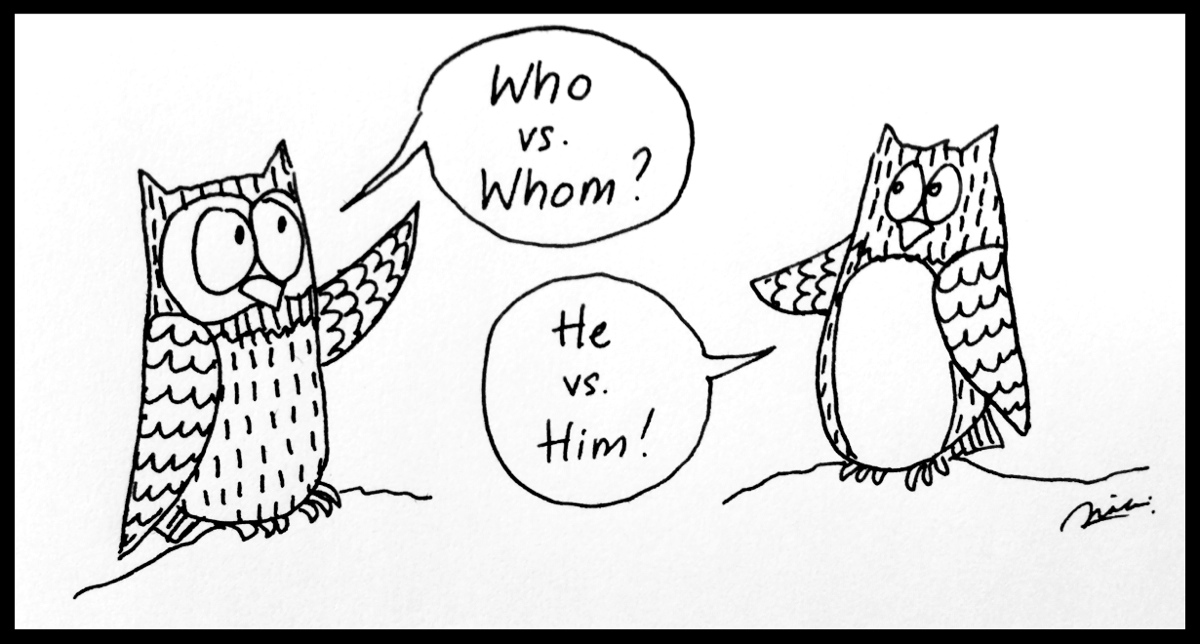
After leaving 4 new vocabulary words today (usurp, vacillate, talisman, expurgate), we reviewed the pronoun handout. Remember, the differentiation between subjective and objective pronouns will help you determine whether it is I or me, we or us, or who (hoot) and whom. For the second half of class, we worked on a partner project involving dialogue. During tomorrow's class, we will share our character conversations and read another example of narrative.
 http://blogs.bu.edu/core/files/2013/10/WhovsWhom2.jpg
Tuesday, September 8, 2015
Narratives & Pronouns
Just a brief synopsis of today's agenda:
1. 4 new vocabulary words.
2. Discussion of "Only Daughter" for its narrative qualities.
3. Pronouns - we focused on subjective and objective pronouns in relationship to verb usage, we reviewed possessive usage of apostrophes and when not to use apostrophes, and we hooted with our who and whom lesson. If you didn't finish up during class time, make sure to have the pronoun handout ready to go for tomorrow.
For Wednesday's class, we will be working on dialogue and how to utilize conversation to understand characters.
1. 4 new vocabulary words.
2. Discussion of "Only Daughter" for its narrative qualities.
3. Pronouns - we focused on subjective and objective pronouns in relationship to verb usage, we reviewed possessive usage of apostrophes and when not to use apostrophes, and we hooted with our who and whom lesson. If you didn't finish up during class time, make sure to have the pronoun handout ready to go for tomorrow.
For Wednesday's class, we will be working on dialogue and how to utilize conversation to understand characters.
Monday, September 7, 2015
Narration
During Friday's class, we began our next mode of discourse: the narrative. There are 5 factors to consider when analyzing and writing narratives. First, every narrative should be centered around a theme. For instance, "Coming to an Awareness" focuses on how education creates empowerment through the experiences of Malcolm X and his time in jail. Second, narratives must consider how to use time, whether for chronological, linear progression or for the manipulation of plot via flashbacks and flashforwards (a word I first heard used in Funny Farm long ago). Third, narratives revolve around characters with the protagonist the most important one. Remember, you want to be selective with whom you place in your story. Fourth, narratives allow one to incorporate dialogue. However, dialogue should be used sparingly and for specific, memorable commentary. Fifth, imagery remains a holdover from descriptive writing. The best stories take the reader into the setting and allow him/her to meet the characters and become part of the plot.
For Tuesday's class, make sure to read "Only Daughter" and prepare responses to the five narrative questions. You will discussing this narrative for participation points, so make sure you are ready to speak.
I hope you have enjoyed your Labor Day weekend. I had the opportunity to visit iheartfink's atelier this weekend and try on a few looks from her runway show. And before you point out my lack of capitalization in the previous sentence, the brand is not capitalized and it is all one word!
And, I did put in the extra credit points. You may want to look at your grades in the next few days as many more assignments will be added into the mix and the grade will inevitably drop to a more realistic number.
For Tuesday's class, make sure to read "Only Daughter" and prepare responses to the five narrative questions. You will discussing this narrative for participation points, so make sure you are ready to speak.
I hope you have enjoyed your Labor Day weekend. I had the opportunity to visit iheartfink's atelier this weekend and try on a few looks from her runway show. And before you point out my lack of capitalization in the previous sentence, the brand is not capitalized and it is all one word!
And, I did put in the extra credit points. You may want to look at your grades in the next few days as many more assignments will be added into the mix and the grade will inevitably drop to a more realistic number.
Wednesday, September 2, 2015
Descriptive Assessment
Today was the last day of descriptive writing. While description sounds rather easy in comparison to the steps and research required in process analysis or argumentation, we have spent a great deal of time focusing on the details (imagery using all of the senses, paragraph and essay structure, hooks and introductions, capitalization, & verb choices). The deadline for the descriptive essay final draft is 3:30 p.m. on Friday, September 4. Turn in hard copy. If you are absent for the entirety of the day, the deadline holds, but you may e-mail an attachment or share with me the essay.
See you on Friday for vocabulary and new stuff --- narratives & verbs!
See you on Friday for vocabulary and new stuff --- narratives & verbs!
Tuesday, September 1, 2015
Yes, Double Space Everything
On the descriptive writing front, Adv. Comp focused on the remaining parts of essay structure: body, conclusion, and MLA format. For tomorrow's class, you will need to have a completed first draft of your relative essay. Do not bring a hard copy as we will be sharing and peer editing via computer tomorrow.
Tips:
- Have your essay in MLA format. If you made a mistake, you can correct it during peer review. (If you need a refresher, head to the additional resources section on the blog.)
- Construct an introduction that hooks the audience and provides a thesis, a direction, for your essay.
- Compose body paragraphs that create round characters, full of imagery and small details that reflect a person's identity.
- Finish with a conclusion that is not a summary. Consider what are the most important, lasting ideas that reflect your family and share that with the audience.
Post-lunch brought vocab quiz 2. Any make-up quizzes must be completed by Friday, September 4.
And, we also reviewed identifying nouns and subjects in order to practice capitalization rules. While capitalization may seem easy, it is a mechanical component, when flawed, that creates a great deal of distractions in student essays. Go here for a recap of the main capitalization rules and start editing your essays for errors: https://owl.english.purdue.edu/owl/resource/592/01/ .
Monday, August 31, 2015
Introductions
As we start essay writing, the introduction becomes the most important component: here you hook the audience, set forth your voice and diction, and provide that all-encompassing thesis statement. For you family essay, you are constructing the ideal introduction, one that could be about brownies, photographs, or even Wonder Woman. Whenever you are writing, you want to strive for the best presentation with clean mechanics. Hence, tomorrow when you come to class, we have a few items on the docket.
1. A vocab quiz on Unit 2. Congratulations to Rowan for his new title of Vocab Champion.
2. Nouns and rules regarding capitalization.
3. Descriptive writing featuring more body paragraphs to exhibit strong, memorable imagery and conclusions that do not rely on regurgitation to end an essay. The result is time to work on your body and concluding paragraphs during class time. We will also review MLA format, and you will have an official due date on the first essay assessment.
1. A vocab quiz on Unit 2. Congratulations to Rowan for his new title of Vocab Champion.
2. Nouns and rules regarding capitalization.
3. Descriptive writing featuring more body paragraphs to exhibit strong, memorable imagery and conclusions that do not rely on regurgitation to end an essay. The result is time to work on your body and concluding paragraphs during class time. We will also review MLA format, and you will have an official due date on the first essay assessment.
Wednesday, August 26, 2015
Family Matters
For the first step of your descriptive writing assessment, you are to choose 3 relatives and write a descriptive paragraph for each one. While this sounds simple, your writing must introduce the audience (your professor and your classmates) to people that we have never seen, heard, or experienced. Therefore, as mentioned in our evaluation meetings today, concentrate on imagery. Sight imagery is important in writing, but you should also consider the sounds, the smells, and the feelings that each person brings when he or she enters a room. You should also consider the balance of subjective and objective details. Neglecting half of these details may create a lop-sided perspective. My lasting advice is to not count lines or sentences on the paper. Instead, concentrate on the descriptive details that will reflect your relatives and create a memorable impression.
With 4 new vocab words today added to the word bank today, Rowan repeats as last person standing. Will he be the new vocab champion, will our reigning champ Colton repeat, or will someone new sneak in and win? That rhetorical question should serve as a reminder to review your vocabulary! See you on Friday - I look forward to "meeting" your family.
Tuesday, August 25, 2015
Choices, Choices, Choices
Tuesday acted as a transition day for Adv. Comp. as we are prepping for grammar boot camp, working on the optional extra credit assignment, and readying for our next descriptive writing.
First, there is the decision of which dual credit program best fits your needs. Option 1 is MOBap's Excel Program. You can find more information here: https://www.mobap.edu/admissions/admissions-dual-enrollment-programs/excel/ . Option 2 is UMSL's ACP, which you can visit here: http://www.umsl.edu/continuinged/acp/ . Option 3 is SLU's 1818 Program here: http://www.slu.edu/1818-advanced-college-credit-program . Remember, the magic deadline is September 4 to Ms. McGill in the guidance office!
Vocab Experts of the Day included new words: sophistry, metamorphosis, interlocutor, nonchalant. Congratulations to Rowan for winning last person standing during our review today!
Wednesday will be full of content with vocab experts, grammar boot camp preparations, and descriptive writing. Don't forget that your one chance at extra credit for this class is due tomorrow -- via hard copy.
First, there is the decision of which dual credit program best fits your needs. Option 1 is MOBap's Excel Program. You can find more information here: https://www.mobap.edu/admissions/admissions-dual-enrollment-programs/excel/ . Option 2 is UMSL's ACP, which you can visit here: http://www.umsl.edu/continuinged/acp/ . Option 3 is SLU's 1818 Program here: http://www.slu.edu/1818-advanced-college-credit-program . Remember, the magic deadline is September 4 to Ms. McGill in the guidance office!
Vocab Experts of the Day included new words: sophistry, metamorphosis, interlocutor, nonchalant. Congratulations to Rowan for winning last person standing during our review today!
Wednesday will be full of content with vocab experts, grammar boot camp preparations, and descriptive writing. Don't forget that your one chance at extra credit for this class is due tomorrow -- via hard copy.
Monday, August 24, 2015
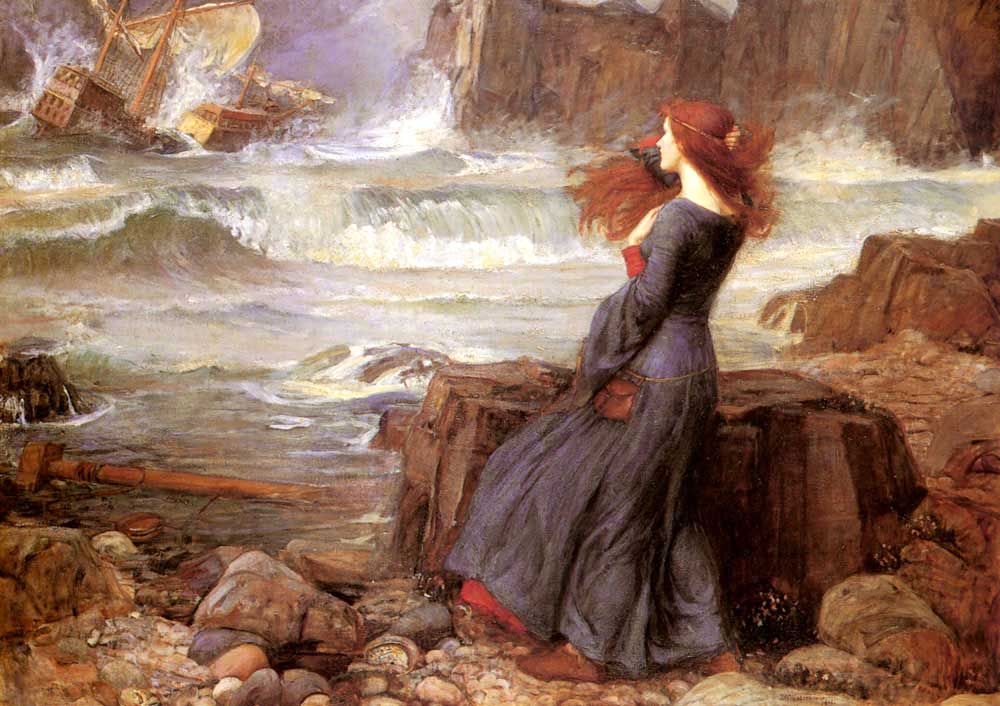
The Descriptive Qualities
 |
| http://uploads6.wikiart.org/images/john-william-waterhouse/miranda-1916.jpg |
Subscribe to:
Posts (Atom)